
Why Traditional Perks Are Not Enough
It would be easily disproved to claim that salary and benefits are no longer important in what gets employees engaged and excited about work. However, they are no longer the only factors driving individuals to consider—and reconsider—job opportunities. Nearly half of working adults would consider a pay cut in exchange for a job where they find meaning in their work and alignment with a company’s mission. That number is even higher among Millennials, with 85% of mid-career professionals stating they would reconsider salary if it meant taking a job with purpose.1
Why Mission Matters More Than Ever
Deriving purpose and meaning from work is not a new phenomenon, nor is it exclusive to early- and mid-career professionals. However, it has become a core contributor to recruitment, engagement, and retention—particularly among younger generations. According to Deloitte’s 2025 Gen Z and Millennial Survey, 89% of Gen Z and 92% of Millennial workers say purpose is important to their job satisfaction and well-being.1
For many of these individuals, work is an essential part of how they see themselves. When asked which factors were most important to their sense of identity, both Gen Z and Millennials ranked work second only to friends and family.
Most Important Factors to Their Sense of Identity
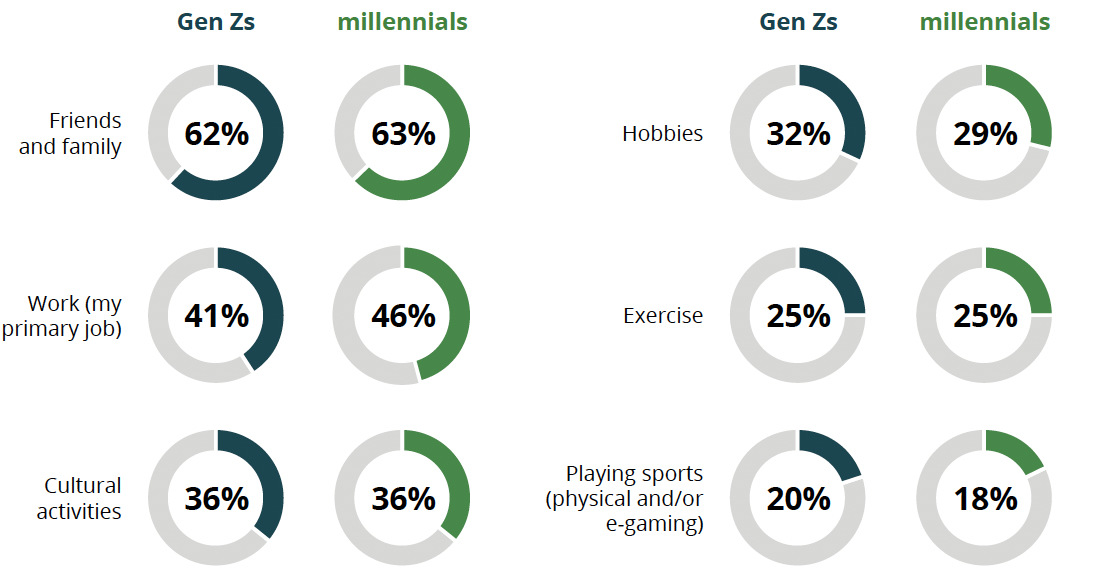
Data table describing the chart appears below.
| Factor | Gen Z | Millenials |
|---|---|---|
| Friends & Family | 62% | 63% |
| Work (primary job) | 41% | 46% |
| Cultural Activities | 36% | 36% |
| Hobbies | 32% | 29% |
| Exercise | 25% | 25% |
| Playing sports | 20% | 18% |
When survey participants were asked about their career goals—and what factors would influence a change in career or employer—their answers consistently came down to three things: money, meaning, and well-being.
Money, Meaning, and Well-Being
Money, meaning, and well-being are all addressed in the U.S. Surgeon General’s Framework for Workplace Mental Health and Well-being, published in 2022. Within this framework are five essentials for creating workplaces that support employee well-being, one of which is Mattering at Work.2
Mattering at Work includes providing a living wage, engaging workers in workplace decisions, building a culture of gratitude and recognition, and connecting individual roles to the organization’s mission.2 When employees do not feel valued or respected, they may experience increased stress, anger, cynicism, and disengagement.
Reinforcing the continued importance of compensation, the first component of mattering is providing employees with a living wage. Work and income are social determinants of health, and concerns about cost of living and financial stability continue to top the list for workers. Nearly half of Gen Z (48%) and Millennials (46%) report feeling financially insecure, with more than half of both generations living paycheck to paycheck.2
Seeking Purpose
Purpose plays a central role in how younger workers evaluate employers. More than 50% of Gen Z and Millennials consider whether work will feel meaningful when assessing job opportunities.1 This same theme emerged when participants were asked about career goals and what would prompt a change in employer: again, money, meaning, and well-being rose to the top.
During the period known as the Great Resignation, employees’ sense of connection to their employer’s mission declined sharply. In 2021, only 38% of individuals felt connected to their company’s mission, and by 2024, that number had dropped to a record low of 30%.3 This decline signals the need for employers to do more than simply restate their mission—it requires real, sustained effort to help employees reconnect with the purpose behind their work. Flashy mission statements alone are not enough; authentic, lived commitment is what drives engagement.
How Employers Can Foster Belonging and Purpose
Jennifer Moss, a globally recognized expert in workplace culture, focuses on helping organizational leaders reduce burnout, increase well-being, and build healthier, higher-performing workplaces. In her most recent book, Why Are We Here?, she outlines how leaders and managers can cultivate purpose and belonging at work.4
Effective leaders and managers:
- Clarify and model the organization’s mission and values
- Help employees understand how their work contributes to something bigger
- Invite employees to share stories about what makes them proud of their work, creating space for feedback and co-creation
- Ensure the employee experience reflects the organization’s stated mission and values
- Recognize the difference between performative purpose and lived purpose
- Address how misalignment shows up as turnover, cynicism, and disengagement
- Invest in inclusive leadership and equitable practices
- Encourage connection through mentorship, Employee Resource Groups (ERGs), and cross-team collaboration
Building Workplaces People Want to Stay In
Compensation will always matter, but it is no longer the sole differentiator it once was. Today’s employees are seeking roles that reflect their values, support their well-being, and allow them to contribute to something meaningful. Purpose, belonging, and alignment now sit at the center of what attracts and retains talent—especially among Gen Z and Millennials.
For employers, this shift presents both a challenge and an opportunity. Rebuilding trust, strengthening mission alignment, and creating environments where people feel valued requires intentional and sustained effort. Organizations that embrace this work—those that live their purpose rather than perform it—stand to gain more engaged employees, stronger cultures, and a workforce energized by impact.
Purpose-driven work is not a trend. It is the foundation of a thriving workplace—and the organizations that understand this will help shape the future of work.
References
- Deloitte. 2025 Gen Z and Millennial Survey. Deloitte, https://www.deloitte.com/global/en/issues/work/genz-millennial-survey.html.
- United States, Department of Health and Human Services, Office of the Surgeon General. The U.S. Surgeon General’s Framework for Workplace Mental Health and Well Being. U.S. Department of Health and Human Services, https://www.hhs.gov/surgeongeneral/reports-and-publications/workplace-well-being/index.html.
- Gallup. State of the Global Workplace 2025. Gallup, https://www.gallup.com/workplace/349484/state-of-the-global-workplace.aspx.
- Moss, Jennifer. Why Are We Here?: Creating a Work Culture Everyone Wants. Harvard Business Review Press, 2025.